
My Thoughts on AI – Classrooms and in General
I’ve been asked about my views on AI in classrooms a decent amount throughout this campaign, and I wanted to write a thorough post I can reference.
TL;DR Long read ahead. If you just want the short answer, jump straight to “Back to the question”.
Most people are looking for quick answers. “Stop The Datacentre” posed this question in an email:
If elected, will you do everything in your power to keep AI off of students’ board-provided devices and out of our classrooms?
I’m going to give them my short answer, which you’ll see on the tracker, but also wanted to spend some time to get my thoughts out. Running for an office, it’s easy to just say “yes” but frankly, my integrity and word means too much for me to provide a straight, one-word answer without guidance to its interpretation, so here it is.
My general thoughts on AI, its impacts on society, and where it’s going
AI is cool – don’t get me wrong, and is highly useful in a lot of specific industry applications. I leverage some AI tools in my workplace, such as for designing documents and floorpans quickly, troubleshooting technology errors, and even checking my grammar for when I forget the “L” in floorplans above.
My hard and fast rule is though – I will not let AI do something for me that I did not understand how it did so. This is where I think a lot of people trip up — this is, on one hand, to keep myself thinking and ensure the results I am producing are from me and not from an ultra-refined rock in a datacentre in Tennessee. It’s great that instead of spending hours mapping a diagram, I can spend 10 minutes to get a starting point and work from there, but the result directly from AI is also just never really what I want. The way people use AI varies, and I don’t think there is any ‘right’ way to use it. I also think that there is always a downside to using it for a task; even as I was writing this article, I did some reading on the ‘blank page effect’ that so many folks encounter going to write a document, looking to sell AI as a way to mind-map and help overcome this. That is until I came across this article by Gary Husband, who drew on challenges and the inspiration from his colleagues to overcome the blank-page effect and write a conference brief. If he used AI to just generate a product from an outline, that would never have happened.
At the same time, I also foresee a turning-point with AI and something that will significantly change the way we use it. AI is extremely expensive: thinking about the difference in how much energy AI datacentres use to parse a single sentence in natural language, versus the human brain (which takes about 20W of power to operate — enough to power a dim lightbulb) it is exponential in nature.
The reason we’re able to use these tools (often for free or at a heavily subsidized cost) despite the massive amounts of energy it consumes, is the fact major companies such as Google, xAI, Anthropic, etc. are in a rapidly-developing arms race for one thing: information. Data on how we interact with computers, how to improve their models, how humans naturally write, the list goes on. At some point (and I believe it to be soon), the value of the data we provide to these companies will be less than the value of the use of their models.
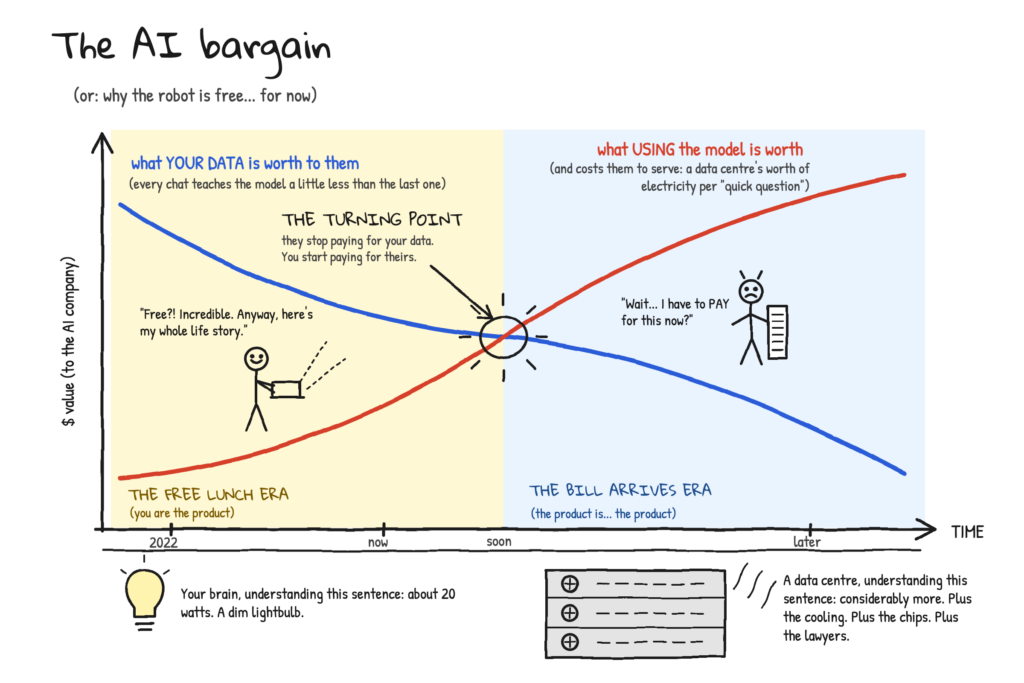
The day this turning point occurs will be a rude awakening (in my opinion, if it happens) for those who have built entire portfolios based on how they can prompt and use AI. It will also cause a massive disturbance in all economic markets for companies that have centred many of their workflows around AI, or even offloaded human employees in exchange for AI agents. Evaluations of per-token costs sell the narrative that the cost of AI has gone down, but we’ve seen heavier, more expensive subscription tiers emerge across AI platforms as people have gone to my latter-referenced model of offloading massive amounts of work onto AI platforms, revealing the real cost of the way many people have been using AI (cognitive-offloading and fully completing projects for them).
Enough of my ramblings – how this worldview applies to my role as a trustee
So what does this mean regarding my stance as a trustee? First off, before I get into what is within my scope — let me make something abundantly clear.
AI datacentres are extremely harmful to the environments around them for both nature and humans.
Some of the research at McMaster which I was privileged to be apart of studied low-noise effects on humans (sounds so low or bass-y, we can’t hear). Here’s one example. We studied this in a positive context, but the point is, low-frequency noise, that you can’t hear, impacts you.
This Benn Jordan video does an excellent job of instilling the fear of the noise emissions and environmental impacts of datacentres that I think everyone should have. Again, I have specific areas of knowledge, and can’t even speak to the water impacts (and the temperature increases that they cause on surrounding bodies of water), energy consumption impacts (which are higher third-order consequences that we see down the line), economic impacts (given the prices of computers to end users increasing and the economic state of the world), and the list goes on. It makes me begin to hope for my ‘turning-point’ hypothesis mentioned above.
Back to the question:
If elected, will you do everything in your power to keep AI off of students’ board-provided devices and out of our classrooms?
Yes-ish. My integrity and word means a lot to me, and saying yes outright would be a lie.
No student-facing generative AI in HWDSB elementary schools — no chatbots, no AI writing or image tools, no AI tutors, on board devices or board accounts. Students should learn what these systems are before they are handed one, and that lesson can be taught without use of AI in the classroom. Staff use for planning can permitted with disclosure and in specific circumstances, no student data entered, human review of anything that reaches students, and never for IEPs or behaviour plans.
Starting with “ish”
- Guaranteeing all AI, everywhere, will be kept off board-provided devices or out of classrooms is not possible. I think any candidate who says yes outright doesn’t realize the breadth of this promise.
- Tools that are essential to learn for students, like Adobe Creative Cloud, Microsoft Office, Google, basic operating systems like Windows and Google, and even Canva (funny how things come full circle, huh?) have AI agents and tools integrated. We need to not just disable these outright, but educate students on how these platforms will be thrown in their face and the impacts, downsides, and even sometimes upsides of using them.
- Completely ‘outlawing’ the use of AI could alienate students actually interested in what it is and how it works. We can’t make AI a naughty word or a crime in schools – we know how teenagers react to you telling them “you can’t do this”. Education is key.
- There is a benefit in educators, who aren’t graphic designers, using AI tools to create graphics or animations to illustrate complex, arbitrary, and theoretical concepts.
The “yes”
- I think in regards to what most people picture when you say “AI” in this question – which are chat platforms like ChatGPT, Gemini, Grok, etc — my answer is astoundingly yes. Hands-down.
- We aren’t in a place where we are ready for AI-based or integrated pedagogy. Especially in K-12 education, educators should do everything in their power to convince their students to stay off AI, and avoid using it for classroom activities. We need to allow time for data (see the trend in my campaign here) and information to be collected in regards to the impacts and use of AI to even consider the possibility of integrating it into classrooms.
- HWDSB should implement, or integrate into existing policy, explicit definitions and acceptable use of AI platforms and use of GenAI – in classrooms and as an organization (even for administrative employees — lead how you act). As of now, and until evidence could be presented otherwise — the guiding principle of this policy should be to keep AI out of the institution as much as possible, and avoid platforms which force AI onto you.
- In addition, some messaging to be mindful that AI companies are harming humans and environments around their datacentres.
- In later school years, like grade 11 and 12, we should consider talking about AI and how they will encounter it, and how to use it properly, with the same messaging aforementioned. As well, highlighting the impacts it has on those who use it to ‘think for them’.
A little bit more information on this policy development and my mindset
I can’t guarantee exact wording of this policy but I can say, as of now, some core guiding principles I will take into this development. I list these because I hope it will be helpful to you (the reader) in your outlook on AI as well.
- Children are built to believe what they are told, and doubt develops slowly.
- Children extend that trust to machines more than they do to people.
- AI systems, as they stand, are built to concur and to average.
- Across 11 frontier models, AI affirmed users’ actions 49% more often than humans did, and a single sycophantic interaction made people more convinced they were right, while sycophantic models were trusted and preferred more. The cause is training on human preference data that rewards agreement.
- WHEN AI DOES THINKING, LEARNING DROPS.
In short, AI platforms are sycophantic — offering unjustified flattery, reinforcement, or encouragement to their users, by design. Teaching a classroom anywhere between grades K-10 that “AI is meant to agree with you, so be careful and don’t trust it” does not actually equip them to critically evaluate its outputs (frankly, even a lot of post-secondary students and adults suffer from this in my opinion).
The expert sources I would ensure are cited in procedure based on this policy
The definition of “policy” and “procedure” is often used ambiguously but there is a very important difference.
Trustees set policy – what the institution wants to accomplish.
Staff set procedure – how, at a high level, the institution will accomplish the policy.
The procedure is a much more living document – and should be guided by the following:
UNESCO Guidance for GenAI in education and research suggesting that GenAI have a hard age-minimum of 13 before classroom use or reference, noting that it may actually be better to raise to 16.
Common Sense Media’s Report on AI Teaching Assistants Needing Better Safety Measures, which outlines where AI-based tools lack in classroom application and what improvements need to be seen before any implementation (still following UNESCOs age restriction).
Ontario Teacher’s Federation specifying the “growing vacuum” of policy and guidance of use of AI in classrooms justifying my referenced need for a conservative AI policy to be implemented, and re-evaluated as time progresses.
If you’ve read this whole article, I appreciate you taking the time to hear my thoughts. A brain-dump about AI is a lot, but hope you got some value out of it.
Cheers,
Cam
Disclosure: Edits after this article has been cited.
Oct 24, 2026: Reading this back, I realize I never tied in my ironic caption of the visualization of “The AI Bargain” to my use of AI creating that image, so I added Canva to my list of specific tools and platforms that integrate AI.